
Fashion was once top-down, ruled by elite designers and runway shows in Paris, Milan, London, and New York. Trends flowed from the catwalk to the consumer, with little room for disruption. But today, the streets—and social media—have become powerful platforms of influence.
Now, street style and runway fashion are in constant conversation, each inspiring the other in a dynamic, democratic cycle. The real question isn’t who leads, but how they interact. Platforms like the Blenders Pride Fashion Tour highlight this evolution, blending the refinement of the runway with the authenticity of the street to shape fashion’s future.
The Cathedral of Couture: Why Runway Fashion Still Matters
Let’s begin with the institution: the runway. To dismiss the power of runway fashion is to ignore the very engine of innovation, craftsmanship, and fantasy that fuels the industry. A runway show is more than just a presentation of clothes; it is a piece of performance art. It is where designers can explore concepts to their most extreme and imaginative conclusions, unburdened by the immediate practicalities of daily life.
Runway shows are where we see:
- Artistic Vision: Designers are artists, and the runway is their gallery. They use fabric, silhouette, and colour to tell stories, evoke emotions, and comment on the world. Take, for example, the legendary Tarun Tahiliani. At the Blenders Pride Fashion Tour in Mumbai, he unveiled his magnificent collection, ‘India Modern,’ on a majestic floating runway. This wasn’t just about selling clothes; it was an immersive experience. The collection, with its segments exploring heavenly silhouettes and innovative reinterpretations of traditional embroidery, showcased exceptional craftsmanship. It was a testament to the power of runway fashion to create a world of fantasy, blending ethereal designs with refined structure—a vision that inspires for seasons to come.
- Technical Innovation: The runway is a laboratory for new techniques and materials. It’s where we first see the application of cutting-edge technology to textiles. A stunning example of this was Akshat Bansal’s collection for his label, Bloni, at the Blenders Pride Fashion Tour in Vizag. Bansal revolutionized the runway experience by incorporating AI-generated visuals, and photochromatic technology that transformed outfits in real time. This is the experimental, forward-thinking spirit of the runway at its best, pushing fashion beyond clothing into a multi-sensory form of expression.
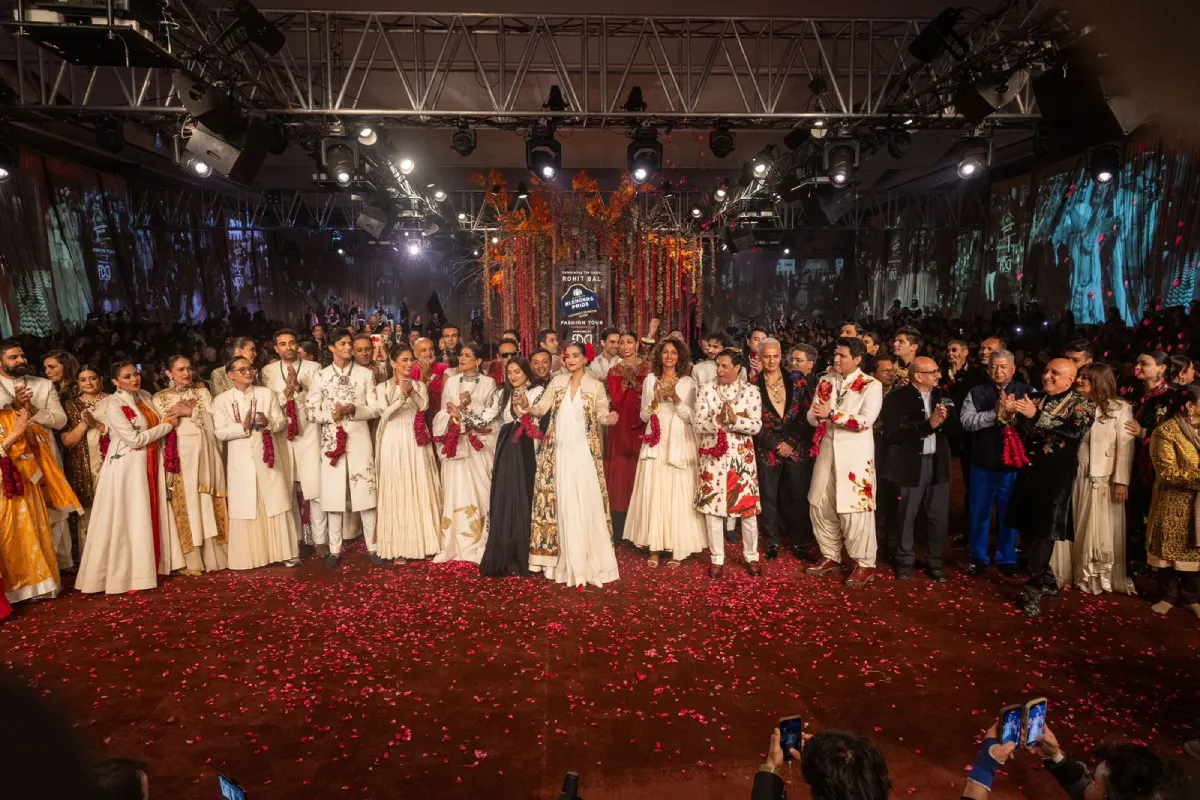
- Legacy and Homage: The runway serves as a vital platform for honouring the masters who have shaped the industry. The opening show of the Blenders Pride Fashion Tour in Gurugram was a deeply moving tribute to the late, great Rohit Bal. Known for his opulent aesthetics and deep connection to Indian heritage, Bal’s impact is immeasurable. The show saw over 100 prominent figures walk the runway in his honour, a powerful demonstration of the runway’s role as a keeper of history and a unifier of the fashion community.
In essence, runway fashion sets the macro trends. It establishes the overarching mood, the key colour palettes, the dominant silhouettes, and the innovative textiles for a season. It provides the high-concept fantasy from which more wearable, everyday trends can be distilled.
From the Sidewalks to the Spotlight: The Democratic Rise of Street Fashion
While the runway was busy building its cathedrals of couture, a quiet revolution was brewing on the pavement. Street fashion is fashioned by the people, for the people. It’s an organic, grassroots phenomenon born not in an atelier, but from the lived experiences of individuals expressing their identity. It’s the language of subcultures—punk, hip-hop, skate, grunge—and the personal flair of everyday citizens.
The ascent of street style fashion was supercharged by technology. The rise of street style photographers like Scott Schuman (The Sartorialist), and later, the explosion of social media platforms like Instagram and TikTok, shattered the industry’s top-down model. Suddenly, a teenager in Tokyo, a student in Johannesburg, or an artist in Mumbai could have as much influence on what people were wearing as a fashion editor in Paris.
Street fashion thrives because of its:
- Authenticity and Relatability: Street style is real. It shows how clothes are worn in the wild—how they are mixed, matched, layered, and adapted to fit a person’s life and personality. It’s not a fantasy; it’s an achievable reality that resonates deeply with a modern audience hungry for authenticity.
- Individuality: At its core, street style is a celebration of self-expression. It’s about breaking rules, not following them. This focus on individuality is a key reason for its appeal, especially among younger generations. The Blenders Pride Fashion Tour, with its emphasis on inspiring young consumers to embrace their unique style, tapped directly into this zeitgeist.
- Speed and Agility: Street trends move at the speed of the internet. A micro-trend can emerge on TikTok, go viral, and be adopted globally in a matter of weeks, long before a designer can even sketch a collection. This agility makes street fashion incredibly dynamic and responsive to cultural shifts.
Modern designers recognize this power. They no longer just look to history or art for inspiration; they look to the streets. The energy of street fashion is now being channelled directly onto the runway, creating a fascinating and energetic fusion.
The Convergence: Where the Street and the Runway Meet
This brings us to the heart of the matter: the old “vs.” is obsolete. The relationship is now a “with.” Runway and street style are locked in a continuous, dynamic feedback loop. The most exciting fashion today exists in the space where these two worlds collide.
The Feedback Loop: A Two-Way Conversation
The cycle works something like this: A designer observes how a particular subculture is wearing vintage denim or how city dwellers are styling oversized blazers. This real-world inspiration is then refined, elevated, and re-contextualized into a runway fashion collection. Editors, buyers, and influencers see these runway looks. They, in turn, interpret them, styling a couture piece with sneakers or a high-fashion jacket with thrifted jeans. These new interpretations hit the streets and social media, inspiring a new wave of street style fashion. This new wave then becomes the inspiration for the next generation of designers, and the cycle continues.
Blurring the Lines: The Modern Fashion Show
The Blenders Pride Fashion Tour, in collaboration with the Fashion Design Council of India (FDCI), exemplifies the merging of fashion, music, art, and entertainment. More than just a runway, it curates immersive experiences that blend the old with the new, the street with high fashion.
Highlights from the Tour:
- Street Luxe in Chandigarh: Designer Kanika Goyal’s edgy collection fused gritty streetwear with runway polish. With Jacqueline Fernandez as showstopper and folk-electronic duo Hari & Sukhmani performing live, the show captured raw street energy in a high-fashion setting.
- Elevating Streetwear: Abhishek Patni’s ‘Racer 01’ for NoughtOne and Pawan Sachdeva’s ‘The Dis-Aligned’ mixed street style with luxury. Both designers showcased the bold, rebellious spirit of streetwear using premium materials.
- Modern Heritage in Guwahati: Nitin Bal Chauhan’s ‘CHAMUNDA’ reimagined medieval armor for modern streets—proving that historical inspiration can live on in today’s fashion. The finale also spotlighted AT-LEISURE wear, a street-born trend now embraced on global runways.
This tour shows that today’s most impactful fashion is hybrid—bold, inclusive, and rooted in both tradition and the street.
The Key Players in the Modern Trend Ecosystem
So, if it’s not just one side, who are the key players setting the trends in this new ecosystem? The cast of characters has expanded significantly.
- 1. The Designers: They remain the visionary artists, the ones with the skill and resources to innovate and create the spectacle. They are the great synthesizers, absorbing influences from art, history, and the street to propose a new direction.
- 2. The People (The Street Stylists): These are the innovators of personal style. Through their creativity and authenticity, they demonstrate how fashion can be lived. They are the trend-starters and the ultimate arbiters of what is cool.
- 3. The Influencers and Celebrities: These figures act as powerful bridges between the runway and the street. When personalities like Ayesha Kanga or creators from the Guwahati edition of the Blenders Pride Fashion Tour take center stage, they translate high-concept fashion into something aspirational yet relatable. They are the new fashion editors for the digital age.
- 4. The Subcultures: From K-pop fandoms to niche TikTok aesthetics like Cottagecore or Dark Academia, tightly-knit communities continue to be powerful incubators of original styles that eventually bubble up into the mainstream.
- 5. The Algorithm: We cannot ignore the silent hand of technology. The algorithms on Instagram, TikTok, and e-commerce sites analyze our clicks, likes, and shares, pushing certain styles and products to the forefront. In a way, they both predict and create trends, forming a powerful, data-driven feedback loop of their own.
Conclusion: So, Who Wins? Everyone
The question posed in the title, “Street Style vs. Runway Fashion,” sets up a false dichotomy. There is no longer a battle for supremacy, because both have won. They have forced each other to evolve. The runway has had to become more grounded, more diverse, and more in tune with how people actually live. The street has been elevated, its creativity and authenticity now recognized as a legitimate and powerful force in the industry.
Runway fashion provides the dream, the innovation, and the ‘what if.’ It pushes the boundaries of what is possible with clothing. Street fashion provides the reality, the personality, and the ‘how to.’ It shows us how to integrate these dreams into our own lives, making them our own.
The real trendsetter in the 21st century is not a single person or institution. It is the creative energy that flows between these two worlds. It is the dynamic conversation, the constant exchange of ideas, the thrilling friction where high-concept art meets real-world application. Platforms like the Blenders Pride Fashion Tour are at the vanguard of this new era, championing the designers who understand this dialogue and creating a space where the spectacle of the runway and the soul of the street can share the spotlight.
The future of fashion lies not in picking a side, but in celebrating the collaboration.